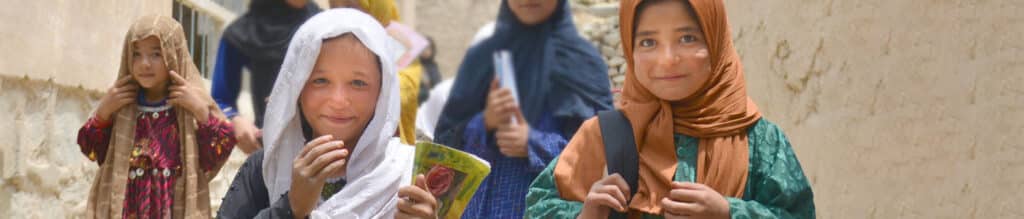
Central Asia Institute has worked in some of Afghanistan’s most remote and hard-to-reach communities since 2001. When the Taliban returned to power in 2021, we stayed. Our commitment to Afghan girls’ and women’s education, voices, and futures has held fast.
Today, Afghanistan is one of the most difficult places on earth to be a girl. An estimated 3.7 million children are out of school, and 60% of them are girls.1 The Taliban’s ban on education for girls beyond Grade 6 has forced 1.4 million girls and women out of school since 2021.2 Only 22% of Afghan women can read and write, versus 52% of men.3 Meanwhile, in rural areas, only 9% of women report earning money of their own.4 In this harsh reality, every classroom opened, every girl learning to read, every teacher trained, and every woman generating income is a quiet declaration that Afghan women cannot be erased.
CAI is among the few international organizations still operating in Afghanistan. We currently support more than 170 community-based primary schools across multiple provinces. In 2025 alone, these schools served roughly 5,000 primary students, of whom 70% are girls. Our community schools offer children safety, encouragement, and the freedom to learn and dream.
We also invest in teachers and women’s livelihoods. In 2025, we supported more than 270 teachers, of whom almost 75% are women, through training and salaries. Beyond the classroom, this year our women’s entrepreneurship program is helping 100+ Afghan women launch small businesses in dairy farming, jam-making, pickling, and other trades. These businesses not only sustain women’s families and strengthen local economies, but also support agency by giving women the resources, skills, and confidence to make and act on their own choices.

1 UNICEF. Education. UNICEF Afghanistan. https://www.unicef.org/afghanistan/education
2 UNESCO. (2024, August 15). Afghanistan: 1.4 million girls still banned from school by de facto authorities. UNESCO. https://www.unesco.org/en/articles/afghanistan-14-million-girls-still-banned-school-de-facto-authorities
3 UNESCO. Community-based literacy and complementary learning possibilities. UNESCO Kabul Field Office. https://www.unesco.org/en/fieldoffice/kabul/expertise/education/literacy-learning-possibilities
4 UN Women. (2025, June 13). Gender Index 2024: Afghanistan. UN Women. https://www.unwomen.org/en/digital-library/publications/2025/06/afghanistan-gender-index-2024