
by Bella Pich
Since the Taliban returned to power, reaching Afghan women with education and opportunity has never been harder. CAI’s partnership with WADAN, a local Afghan organization, makes it possible.
It is easy to believe that the unimaginable happens somewhere else. For many of us, the idea of losing the right to attend school, work, move freely, or participate in public life is difficult to comprehend. For the women and girls of Afghanistan, however, these are not hypothetical concerns. They are the realities of daily life.
Since the Taliban returned to power in 2021, the rights of Afghan women and girls have been stripped away almost entirely. Girls are barred from school beyond grade 6. Women are barred from most employment, and increasingly from public life itself.
Where so many organizations have been forced out, the Welfare Association for the Development of Afghanistan (WADAN) has stayed, continuing its work even as the space to do it keeps shrinking. Founded in 2002, WADAN works to strengthen the capacity of Afghan citizens to build a healthy, peaceful, and developed Afghanistan, with a focus on sustainable development, social justice, human rights, and grassroots governance across the country’s diverse communities.¹
“For WADAN, staying means standing with communities when support is most needed,” explains Khalilullah Tawhidyar, WADAN’s Education Manager. “Our commitment is not simply about implementing a project; it is about building trust and remaining accountable to the women and families we serve.”
Central Asia Institute (CAI) has partnered with WADAN since 2022. Since then, the partnership has expanded access to education by covering teacher salaries, training, operational costs, and learning materials, while also delivering technical mentoring and entrepreneurship programming built around dairy processing and livestock rearing.
Education remains the foundation of this work. The Taliban’s ban on girls’ education above grade 6 has forced an estimated 2.6 million girls out of school.² Millions more never reach a classroom at all, and with each year that passes, the country’s supply of educated women shrinks further.
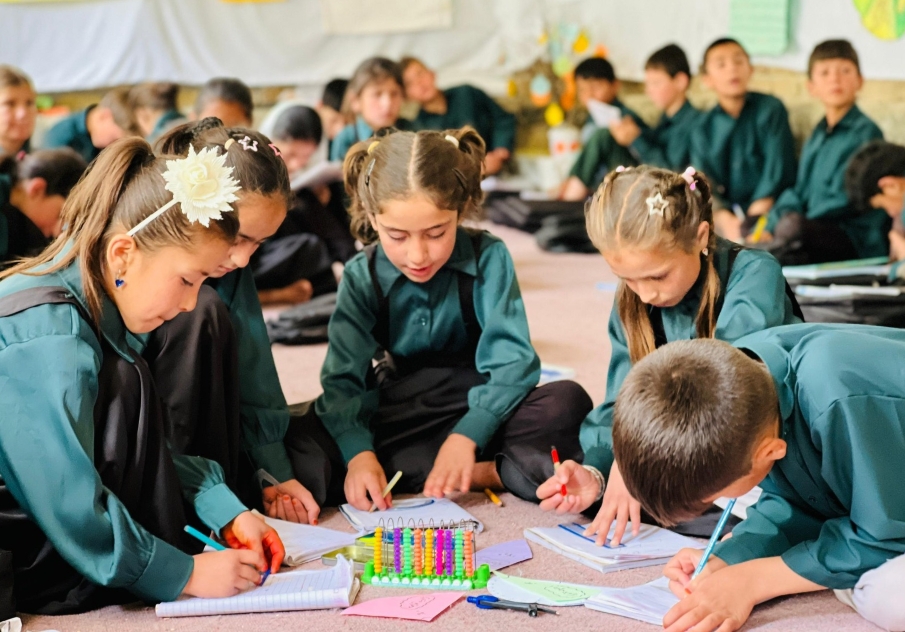
The one door that remains open is primary school, and in much of rural Afghanistan, community-based education (CBE) is the only way through it. CBE classes are not schools in the conventional sense. They are small — typically 25 to 35 students — and meet in whatever space a village can offer: a spare room in a family home, a mosque, a community hall. They are taught by local teachers, often women from the community itself, which is exactly why families trust them. For a girl whose nearest government school is a two-hour walk over mountain roads, or whose parents will not send her to a classroom staffed by strangers, a CBE class is the difference between learning to read and never learning at all. The model is proving its worth: in the first half of 2026, UNICEF supported nearly 56,000 vulnerable children through community-based education and temporary learning spaces, and 67% of them were girls.3
This is where WADAN and CAI have concentrated their effort. By bringing primary classrooms directly to the communities that need them, WADAN reaches children the formal system never will. Today, WADAN oversees more than 72 community-based schools serving over 2,130 children. The numbers are real, but they only begin to capture what is at stake: every girl who finishes grade 6 in one of these classrooms leaves with something that cannot be taken back.
The consequences are deeply personal as well as national. To move through the world without the ability to read is to navigate much of life in the dark. Street signs offer no direction. Prescription labels provide no guidance. Forms, contracts, and written instructions become barriers rather than tools. A woman who cannot read must constantly depend on others to interpret information that affects her health, finances, and future. Literacy is not simply about education; it is about independence. It is the ability to make informed decisions, advocate for oneself, and participate fully in society. And every teacher, nurse, health worker, and community leader begins as a student, produced by the same primary schools now under increasing pressure.
For women who have been shut out of education and excluded from much of the workforce, opportunity must often be created where it still can exist: within their homes and communities. That is the purpose of CAI’s Women’s Entrepreneurship Program (WEP).
In Afghanistan, the WEP’s centerpiece is a Dairy Processing and Livestock Rearing initiative implemented in partnership with WADAN. Women receive intensive training in dairy production, herd management, and small-scale business development before joining cooperatives that produce and sell milk, yogurt, and cheese within their communities. The program provides livestock, equipment, and seed funding to help participants get started, while WADAN staff offer ongoing mentoring as the businesses take shape. From there, women grow their skills, their incomes, and their confidence alongside one another, batch by batch.
To date, 45 women have completed the training and launched cooperative enterprises. While the program cannot undo the systemic barriers Afghan women face, it offers something equally important: a pathway forward. Each business generates income for a family. Each cooperative creates a network of support and shared knowledge. And each woman who builds a livelihood through the program demonstrates that even in an environment designed to limit opportunity, resilience and initiative can still prevail.
“When a woman receives training, an income-generating asset, a business kit, or access to mentoring, she can turn that support into something that benefits an entire household,” says Tawhidyar. “That is why investment in Afghan women has a multiplier effect. When we invest in one woman, we are often investing in an entire family — and ultimately, in the resilience of a community.”
Central Asia Institute remains committed to standing beside partners like WADAN — because they are closest to the communities and know best how to create impact in a complex and ever-shrinking space, and because local organizations like WADAN must be the leaders and visionaries of Afghanistan’s future. We don’t take this relationship for granted.
Every classroom that opens and every business that launches is a quiet refusal to let exclusion have the final word. The women and girls of Afghanistan have not given up. Neither will we.
“Together, we can turn resources into tangible opportunities,” Tawhidyar reflects. “The strongest evidence of this partnership is not only the number of women reached but what happens afterward: women generating income, supporting their families, reinvesting in their businesses, gaining confidence, and becoming examples for others.”
1WADAN (The Welfare Association for the Development of Afghanistan), https://wadan.org/
2UNICEF USA, “Afghanistan’s Education Ban Robs Girls of Their Future,” https://www.unicefusa.org/stories/afghanistans-education-ban-robs-girls-their-future
3UNICEF, “Afghanistan Humanitarian Situation Report, 1 January – 30 June 2026,” https://www.unicef.org/afghanistan/documents/unicef-afghanistan-humanitarian-situation-report-1-january-30-june-2026