
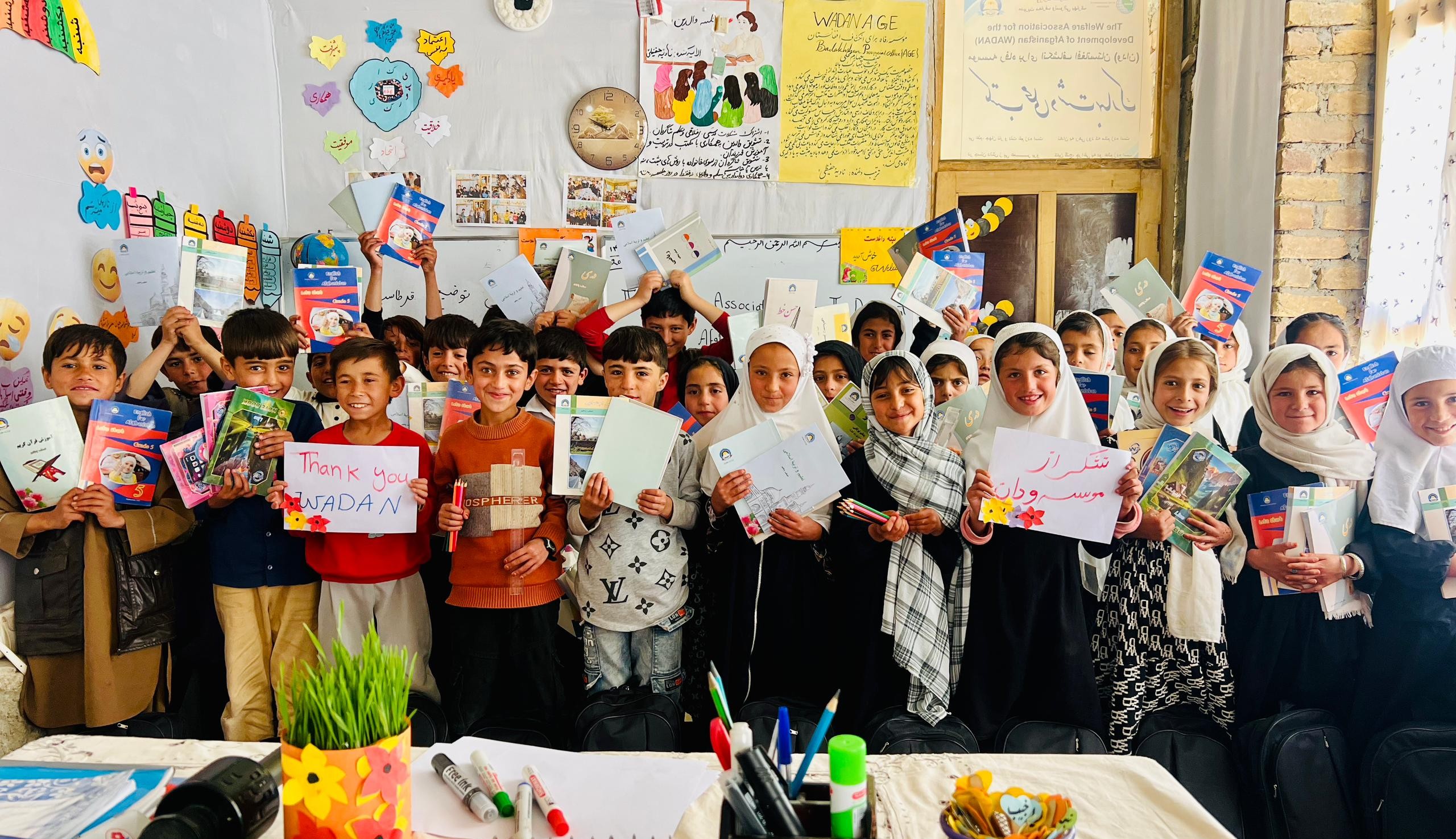
Why the first years of learning matter most — and how Central Asia Institute’s new Director of International Programs is putting them at the center of everything we do
by Alice Thomas
In the mountains of Afghanistan and Pakistan, geography has long been destiny. Villages scattered across the Karakoram and Hindu Kush ranges are cut off from one another by valleys, rivers and towering peaks.
For children in these remote communities, distance from the nearest school can mean the gap between a future full of possibility and one shaped by limited opportunity, few pathways to stable employment and generations of poverty that are difficult to escape.
Central Asia Institute (CAI) is here to close that gap. And no one on our team understands what’s at stake in those first years of learning better than Anh Pham, CAI’s new Director of International Programs.
During Anh’s 18 years in international development, including 15 years as a diplomat and Foreign Service Officer with USAID, she saw firsthand how underperforming schools, stagnant economies and poverty can reinforce one another. She also witnessed how investments in education and workforce development, particularly for women and young people, can create lasting change that extends far beyond the classroom.
Having managed programs across Asia and Africa, Anh has learned that transformation often begins with the fundamentals. Before students can continue their education, secure better jobs or strengthen their communities, they need a strong foundation in literacy and numeracy. That foundation, she says, is where meaningful change begins.
The Crisis Hiding Inside the Classroom
Enrollment is not the same as learning. Throughout her career, Anh has seen the global learning crisis up close. Millions of children are never given the opportunity to attend school, but even among those who do, many spend years in a classroom without ever mastering basic reading or arithmetic. The World Bank calls this “learning poverty” — the inability to read and understand a simple text by age 10. In many low-income countries, it affects the majority of children.
The consequences extend far beyond the early grades. Children who do not learn to read with comprehension struggle to build the knowledge and skills that come later. But literacy does more than support academic achievement. It opens the door to a world of information, allowing a child to learn independently, engage with technology, and expand their horizons. Over time, those foundational skills are linked to greater employability, higher earnings, and stronger economic participation. Literacy and numeracy are not simply educational milestones; they are among the strongest predictors of future opportunity.
What Is Foundational Learning?
The basic set of skills that form the building blocks for all future learning, in three areas:
- Literacy — reading and writing, including the ability to read with comprehension rather than simply decode words.
- Numeracy — counting, arithmetic and understanding numbers well enough to use them in everyday life.
- Cognitive and social-emotional skills — attention, memory, self-regulation and the ability to work with others, which determine how well a child can absorb and use everything else.
“Foundational learning is so important to any young population — learning how to read, write and do math. And if you add in social-emotional learning, you learn, in layman’s terms, how to be a good human being. These are what build the foundation for any society.”
Pakistan illustrates the challenge. Although primary school enrollment in government schools in Gilgit-Baltistan, the mountainous region where CAI works, is relatively high compared to many other parts of the country, enrollment does not necessarily translate into learning. Nearly 40% of third-grade students cannot perform basic arithmetic, and roughly 37% are unable to read simple sentences.1
The gap illustrated in Pakistan, between being enrolled in school and truly learning, highlights why foundational literacy and numeracy must remain at the center of educational efforts.
Measuring What Matters Most
CAI’s community-based approach is designed to address these challenges. In the remote regions of Afghanistan and Pakistan where CAI works, getting children into school is a critical first step. Because government schools are often inaccessible, CAI partners with communities to establish local schools, convert community spaces into classrooms, recruit and support teachers, and provide books and learning materials. But access alone is not enough. What ultimately matters is whether children gain the foundational skills that allow them to learn, grow and succeed.
After establishing a community school or classroom, CAI helps create School Management Committees (SMCs) made up of parents, village elders and other local leaders. These committees oversee school operations, track attendance, and support student success. When a child stops attending classes or begins to fall behind, SMC members work directly with the family to understand and address the barriers.
Accountability extends beyond enrollment and graduation rates. CAI independently measures student progress in reading, writing and basic mathematics to ensure children are gaining the foundational skills they need. When learning outcomes fall short, targeted interventions are introduced, such as additional teacher training and instructional support. By investing in teachers, school leaders and SMC members, CAI strengthens local capacity and cultivates community ownership, ensuring that progress continues long after the initial investment has been made.
The Multiplier Effect
In Anh’s experience, foundational learning is one of the best investments in development. “There was data that found a child who has foundational learning will earn, on average, 16 percent more income in life than a child who does not. The evidence on this is pretty strong.”2
Anh points out that foundational learning is particularly powerful for girls. When girls gain literacy and numeracy skills, the effects extend well beyond the classroom, strengthening household incomes, improving family decision-making and increasing investment in children’s education. The benefits can last for generations: children of educated mothers are 67% less likely to die in infancy.3
For girls growing up where educational and economic opportunities are scarce, foundational learning can open the door to greater confidence, independence and opportunity. Literacy enables girls and women to understand information, manage finances, access services, navigate institutions and participate more fully in society.
What a School Means In a Conflict Zone
Early on in her career, Anh learned the critical importance of providing access to quality education for children living amid conflict and instability. In 2013, Anh took an assignment working on health and education in Afghanistan.
“When you work on education in a conflict environment, it is a life-saving program. It keeps kids safe. Schools become safe spaces, providing children with normality and routine, which is really grounding for children living in conflict. And once they learn, you can’t take that away from them. What is more sustainable than education? Once you teach a kid to read, no one can take that away.”
That conviction is what Anh brought to CAI in 2025, when she became Director of International Programs, overseeing our education and women’s economic empowerment portfolio. Her priority here is deceptively simple: making sure the more than 14,000 primary-level students CAI serves in Afghanistan and Pakistan are truly learning to read, write and do math.
Learning So That You Can Thrive
Anh also leads CAI’s Women’s Entrepreneurship Programs in Afghanistan, Pakistan and Tajikistan, which she views as the next step in the journey beyond foundational learning.
“There is learning for learning’s sake, and there is learning so that you can thrive,” she says. “Entrepreneurship programs help women put education into practice. Financial literacy, for example, gives them the confidence and skills to earn an income, build a business and become more independent.”
She has seen that resilience firsthand. “My mom was always the one who managed the family budget. I don’t know how my parents raised five children on so little. Women are incredibly resourceful. They find ways to stretch every dollar and make things work. When they’re given formal financial and business training, they can accomplish extraordinary things.”
It is a simple idea, and one that guides much of CAI’s work: Education creates opportunity, and opportunity creates choices. Together, they can change the trajectory of a life.
The Ripple
The impact of this work extends far beyond test scores and graduation rates. Parents who once hesitated to send their daughters to school now encourage them to stay and succeed. Teachers who once worked with few resources become leaders in their communities. And villages that once had little access to education begin to build cultures where learning is expected, valued and passed from one generation to the next.
Anh has seen those changes firsthand. Years ago, while working in Cambodia, she helped design a workforce development program for young people. As is often the case in the Foreign Service, she moved on to another post before seeing its long-term results.
Then, after the COVID-19 pandemic, a former colleague reached out with an update. The project had established Cambodia’s first career center, providing business and digital skills support for youth, particularly girls and young women., One participant, still a high school student, had chosen to become a mentor to younger girls herself and teach them how to code.
For Anh, the story captured the true power of education and opportunity. When people gain the skills and confidence to improve their own lives, they often go on to help others do the same. The benefits do not end with the person who receives them. They are carried into families, workplaces and communities, creating opportunities for others long after the original investment has been made.
“Give an opportunity to one participant, and she is so inspired that she feels compelled to help other girls. When you leave a project, you always worry. To learn that it was having this effect — that’s the power of girls, right?”
Students become teachers. Teachers become principals. Communities become models for others to follow.
That is the CAI impact — and it compounds.
1ASER Pakistan. (2011-2023). Annual Status of Education Report. Retrieved from https://aserpakistan.org/report.
2 In fact, research has found that in Pakistan, children who gain strong foundational learning skills will earn up to 28 percent more each month as an adult. https://www.wwhge.org/resources/new-evidence-confirms-the-transformative-power-of-foundational-learning-skills-for-individuals-and-societies/
3 Balaj, Mirza, et al. “Parental Education and Inequalities in Child Mortality: A Global Systematic Review and Meta-Analysis.” The Lancet, vol. 398, no. 10300, 2021, pp. 608-620.