
By Seelai Karzai
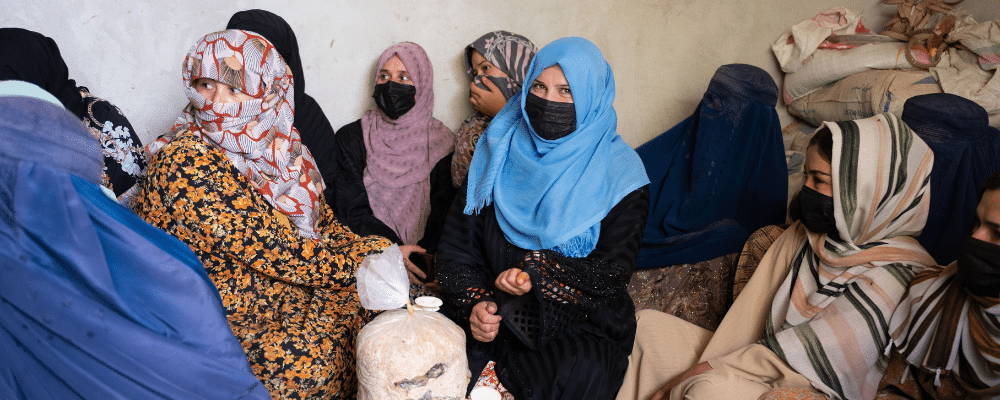
Across Afghanistan today, women face some of the most severe restrictions on their rights to education, healthcare, work, and freedom of movement in the world. These conditions are so severe that they amount to gender apartheid—a term that has not yet been defined in international law, but which accurately describes the repressive conditions the Taliban have imposed on Afghan women and girls through dozens of edicts since 2021. At the same time, the persecution that Afghan women must endure under Taliban rule is being compounded by other factors, including recent cuts to U.S. humanitarian assistance, which are disproportionately affecting women and children. This reality is a stark reminder for us all to remain committed to advocating for international policies that better protect Afghan women and girls.
On March 4, 2026, the Georgetown Institute for Women, Peace and Security and the Afghanistan Institute for Peace and Stability held the webinar “Voices from the Margins: Lived Realities of Rural Afghan Women,” which highlighted what must change to support Afghan women and girls. This insightful event delved into new research findings that reveal the challenges many Afghan women face every day. Over nine months in 2025, drawing from 802 surveys and 82 in-depth interviews, the all-volunteer research team—composed of Storai Tapesh, Robina Hamdard, Muqadasa Ahmadzai—found the following:
- 94% reported going hungry
- Nearly 57% of births occurred without medical assistance
- Nearly 40% reported there are no income opportunities for women
- Most women cannot leave their homes without a mahram, or male guardian
The findings also revealed broader attitudes within Afghan society regarding women’s rights and how the international community can better respond to their needs. The research team at the Afghanistan Institute for Peace and Stability learned that broader Afghan society, including men, supports education for girls. Furthermore, the Afghan women they spoke with specifically called for expanding community- and home-based education for girls in rural areas.
At the Central Asia Institute, these findings were encouraging and confirmed our organization’s experience working in rural areas in Afghanistan since the Taliban regained control. Since 2021, CAI has supported hundreds of community education classes for girls. Time and again, we have seen the positive impacts of this community-based education: our own data shows that, overwhelmingly, students in CAI-supported community schools thrive. By focusing on girls in rural areas and providing safe, local access to primary education through Grade 6, our students have higher retention rates, earn higher grades, and demonstrate better learning outcomes than their counterparts in government schools.
Another misconception highlighted by the research team is that Afghan women inside the country are passive. Instead, the research found that many Afghan women have worked around restrictions on access to education and employment through informal education initiatives, home-based economic activities, and community support networks. These findings demonstrate that when Afghan women are supported—even in rural areas often considered more conservative—they assert agency, change their circumstances, and improve their lives.
The research team also cited several external barriers holding women back, including lack of access to financing, skills gaps, and poor infrastructure. To mitigate these challenges, the Afghan women interviewed identified their top priorities for improving this dire economic situation: supporting women’s home-based livelihoods through grants and mentoring; expanding women’s access to markets; providing microgrants and business support; strengthening women’s savings groups; and promoting procurement from women-led businesses.
Beginning with a pilot program in 2025, CAI has been working to address these needs. Our Women’s Entrepreneurship Program in Afghanistan exemplifies how CAI supports the well-being and economic inclusion of Afghan women. Working with our in-country partners, we are proud to share that in just six months’ time, women reported a 50% increase in their income, along with increased confidence—effects that ripple across their families and communities. When the young daughters of self-reliant Afghan women see what is possible for themselves beyond the cloud of arbitrary restrictions, everything changes.
Supporting women’s economic inclusion and education for all women and girls is one step toward undoing the damage caused by the Taliban’s restrictions over the past four—going on five—years. Under conditions of gender apartheid in Afghanistan, we must support the voices of underserved rural Afghan women and help improve their lived realities.
We invite you to learn more about CAI’s Community-Based Education Program for Afghan girls and our Afghan Women’s Entrepreneurship Program by visiting our website, reading our success stories, or listening to Afghan women participants in our programs. We hope you will join us by supporting Afghan women and girls—by signing up for our newsletters, joining our webinars, or following us on social media for updates on our Afghan Women’s Entrepreneurship Program. We also encourage continued support for this kind of research, which improves understanding of societal attitudes and the needs of Afghan women while keeping international attention focused on the enormous challenges they face every day.
Seelai Karzai is Central Asia Institute’s Communications Manager. Previously, she served as Afghanistan Advocacy Campaign Manager at Human Rights First.
Sources:
Afghanistan Institute for Peace and Stability. (2026, February 25). Voices from the margins: Lived realities of rural Afghan women. Georgetown Institute for Women, Peace and Security. Retrieved from https://giwps.georgetown.edu/resource/voices-from-the-margins/.
UN Women. (2025, August 14). Afghanistan: Ten facts about the world’s most severe women’s rights crisis. Retrieved from https://www.unwomen.org/en/news-stories/press-release/2025/08/afghanistan-ten-facts-about-the-worlds-most-severe-womens-rights-crisis.