
by Emilie Saunders
Eleven thousand feet up in the Karakoram Mountain Range of Gilgit-Baltistan (GB), there is a village called Dapa. Snow closes it off for months at a time. The families who live there survive on agriculture and livestock. There is one small school available for girls.
In another remote village, Malpan Sadpara, also nestled among the towering peaks of Karakoram in GB, the circumstances are much the same: isolation, limited resources, and a single small school.
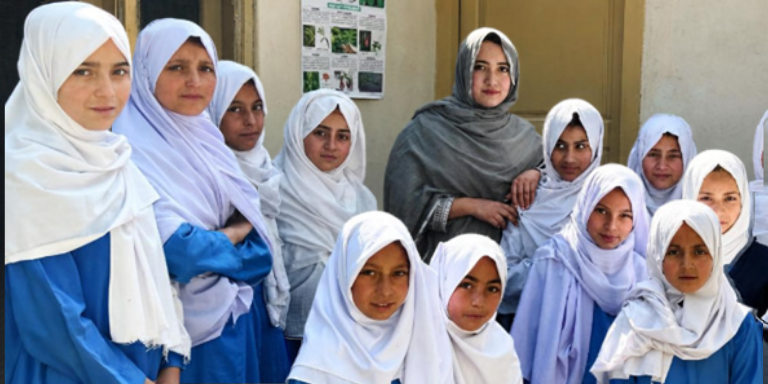
Each of these schools was founded by the Central Asia Institute (CAI) decades ago in partnership with local communities committed to educating their children. With continued support from CAI, the schools are now sustainably co-managed by the communities themselves and our local partner, the Moawin Foundation. And in each, a woman teaches in the same classroom they once attended as a student. Each woman left her village to continue her education beyond grade 5, where both schools ended. Each graduated. And each, given the opportunity to build a life elsewhere, with paved roads and reliable electricity, chose to return home.
Their names are Shehnaaz Batool and Nusrat Fatima. Odds are slim they have ever met, but what they have in common is not a coincidence. It is the most important thing happening in education in the remote regions of Pakistan, and almost nobody outside these remote villages knows it is happening at all.
What a Remote School Cannot Do
Pakistan has between 25 and 26 million children out of school — roughly 38% of the school-age population and one of the highest rates in the world.¹ Education spending has fallen to about 0.8% of GDP, a record low, far below the UN-backed benchmark of 4% to 6%.²
While school enrollment numbers in the Gilgit-Baltistan region are better than in other parts of the country, school attendance, especially among girls and poorer households, remains a challenge. According to UNICEF, the net attendance rate among primary school aged children in GB is 47.4% (23% among girls and 27% for boys), meaning less than half of children attend primary school; among GB’s poorer households, net attendance is only 36%, meaning more than 60% of children don’t attend school at all.3
The crisis may be measured in millions, but lasting change is measured one child at a time. In Dapa, the number that matters is not 26 million. It is one.

A village school at 11,000 feet, cut off by snow for a third of the year, cannot recruit teachers from the city. It cannot compete on salary, housing, amenities, or career opportunities, nor can it offer the advantages that typically draw professionals to remote postings. When a teacher leaves Dapa, there is no pool of qualified candidates waiting to replace them. There is simply a school without a teacher.
Which often means a remote community has only one reliable source of educators: the girls who grow up there. In places like Dapa and Malpan, girls’ education and teacher recruitment are not separate challenges. They are the same challenge, separated by about 15 years.
Shehnaaz
Shehnaaz Batool attended Community School Dapa from preschool through grade 5.
The school was small, remote, and short on resources. Yet it gave her something invaluable. Beyond teaching her to read and write, her teachers instilled confidence, discipline, and curiosity. Most importantly, they believed she could continue her education and told her so at an age when many girls in mountain communities hear the opposite.
For Shehnaaz, continuing was not easy. Her family had limited financial means, and there was no school beyond grade 5 in the village. Pursuing an education meant overcoming distance as well as cost.
Still, she continued.
Shehnaaz, 24, now teaches Early Childhood Development at Community School Dapa in the same classrooms where she once sat as a student.
“I was once a little girl sitting in these classrooms, dreaming of becoming someone who could make a difference. Today, by the grace of Allah Almighty, I have returned as a teacher. Every child I teach reminds me of my own journey.”
One girl becomes a teacher. Suddenly, other girls can see what is possible.
Nusrat
In Malpan, a similar story unfolded for a girl named Nusrat Fatima.
Nusrat attended Bushra Inspire Primary School through grade 5. During those years, she was taught by a man named Muhammad Ayub, whom she still credits, by name, with convincing her that education was worth the sacrifices it would require. His encouragement helped shape what she believed she could become.
Overcoming the obstacles that cause so many girls in isolated villages of Gilgit Baltistan to leave school, she continued her education beyond grade 5. With hard work and determination, she qualified as a teacher and eventually returned to Bushra Inspire Primary School, where she now teaches.
Note the chain created: a teacher named Ayub taught a girl named Nusrat. Nusrat now teaches the children of Malpan. And in the future, some of those children may teach the next generation.
Three generations are visible in that single chain. And the whole thing rests on a small primary school with limited resources, vulnerable to closure in a single difficult year.
What Disappears
Consider what the village of Dapa loses if Shehnaaz leaves.
Beyond the loss of a classroom and its teacher, Dapa would lose something else as well: the example. The parents who changed their minds about educating their daughters did so because of a specific woman they can see standing at the front of a classroom each day. Remove her, and the argument becomes theoretical again.
This is what makes teachers in remote communities different. In a city, a teacher who leaves is replaced and the institution endures. In Dapa, the teacher is the institution. She is the educator, the role model, and the bridge between one generation of students and the next.
Nobody calls this heroism, least of all the women doing it. But there is no other word for returning every morning to an isolated mountain village, armed with too few resources and too little support, because you know that if you do not show up, no one else will.
What Teacher Support Actually Means
CAI’s teacher programs are not glamorous. They consist largely of training, materials, and sustained support. That is the intervention. For a school in Dapa, it can mean the difference between remaining open and closing its doors.
Training allows young teachers to keep growing rather than plateauing in isolation, and it gives experienced teachers a reason to believe their careers still have somewhere to go.
Materials are the unglamorous essentials that always seem too few in remote classrooms like Dapa’s: books, child-friendly learning materials, and the everyday tools of education.
Continuity is the ingredient nobody notices until it disappears. A school that families trust will be open next year is a school they will send their daughters to. A school that may not exist next year is a risk, and families in places like Dapa cannot afford risks.
The Next One
In the village of Chokdo Nar, nestled in the Shigar Valley, lives a 21-year-old woman named Amina.
Growing up, her village had just one school, limited learning materials, and few trained teachers. She walked long distances through difficult weather to attend classes, determined to learn despite the obstacles. Her dedication stood out, and teachers recognized her potential, encouraging her to continue her education, much as they had with Shehnaaz and Nusrat before her.
Today, she is pursuing her education with a clear purpose: to become a teacher. More than that, she hopes to mentor and inspire children, especially girls, in communities where educational opportunities can feel out of reach.
She has not yet returned to her home village. For Amina, that decision still lies ahead.
Whether she follows the path of Shehnaaz and Nusrat will depend on factors far beyond her control: whether there is a school to return to, whether there is a salary to earn, and whether the position comes with the support and resources needed to succeed, or whether it means years of working alone in an under-resourced classroom.
That is why teacher support matters. It not only helps educators who have already chosen to serve their communities, but also ensures that promising young women like Amina can see a future worth returning home for.
What’s Ahead
Shehnaaz wants to introduce new teaching methods, make her classroom more engaging for young children, and, most importantly, inspire other young women from remote communities to get an education and return to serve their own villages.
In other words, she is trying to replace herself. Repeatedly. Indefinitely.
Nusrat has similar goals. Her hope is to encourage more girls to pursue an education and achieve their ambitions, regardless of the obstacles they face.
Neither woman is trying to be a hero. Both are trying to build something that will outlast them, in places where nothing about the future is guaranteed.
Somewhere in the Shigar Valley, 21-year-old Amina is deciding whether to join them.
“I want them to believe that no matter how remote their village or how difficult their circumstances, education can change their lives. If I can achieve my dreams, they can achieve theirs too.” — Shehnaaz Batool, Community School Dapa
1Save the Children, “Education spending in Pakistan hits new low with more than one in three children out of school,” 19 June 2025; Civil Services Academy policy review, 2026.
2Pakistan Economic Survey 2024–25, as reported by Save the Children and UNICEF Pakistan. Education spending at approximately 0.8 percent of GDP against the UN-backed Incheon Declaration benchmark of 4–6 percent.
3UNICEF. (2025, December). Gilgit-Baltistan Multiple Indicator Cluster Survey 2024-25.